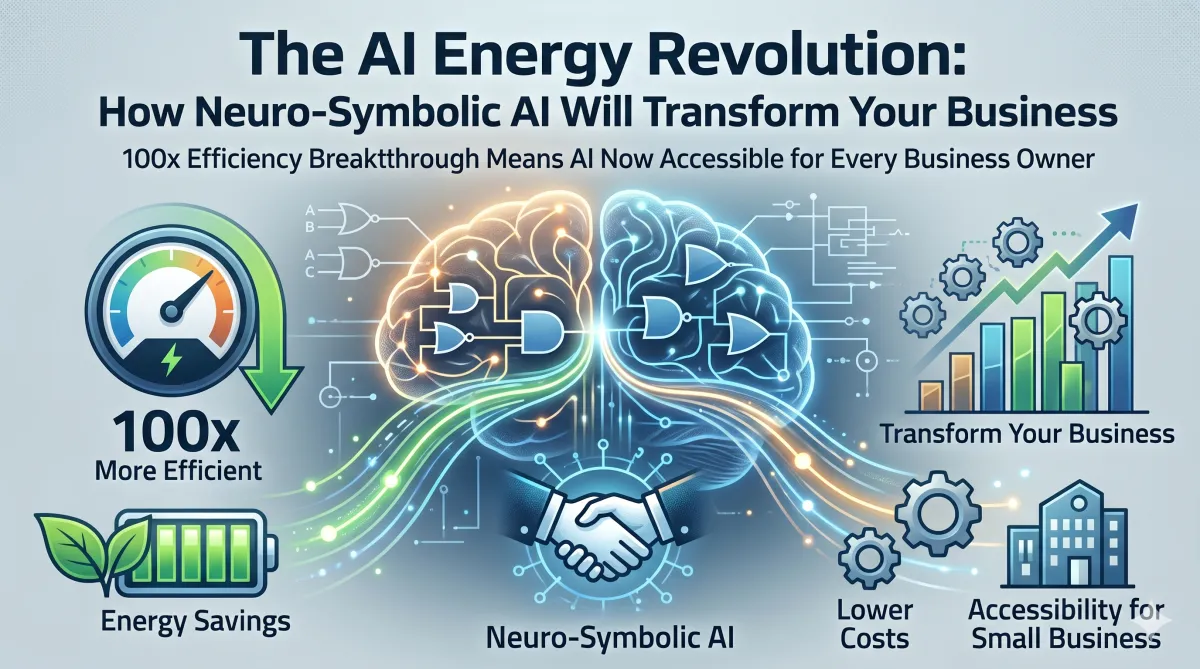
The AI Energy Revolution: How the door just opened for dramatically cheaper AI
AI just became 100 times more efficient. Here's what this breakthrough means for every business owner.
The Hidden Cost of AI That's Been Holding Your Business Back
Picture this: every time you use ChatGPT, Google's AI, or any sophisticated artificial intelligence tool, you're tapping into systems that collectively consume 10% of all electricity generated in the United States. To put that into perspective, that's more power than entire cities like San Francisco or Boston use for everything—lighting, heating, transport, and industry combined.
This staggering energy consumption isn't just an environmental concern (though it certainly is that). It's been the invisible barrier preventing small and medium businesses from accessing truly powerful AI capabilities. The computational costs have been so enormous that only tech giants with unlimited budgets could afford to run the most advanced AI systems.
But everything just changed.
I'm Chris Burrows, your Applied AI and Automation consultant who's helped countless entrepreneurs turn their struggles into success. Today, I want to share news that will fundamentally alter how you think about AI in your business.
The Problem: Why Traditional AI Devours Energy
To understand why this breakthrough matters, we need to grasp why current AI systems are so energy-hungry in the first place.
Traditional artificial intelligence, particularly the large language models powering tools like ChatGPT, operates on what's essentially a brute-force approach. These systems use vast neural networks—millions or billions of artificial neurons—that process information through trial and error, making countless calculations to arrive at each answer.
Imagine trying to solve a complex puzzle by randomly trying every possible combination rather than using logical reasoning. That's essentially how current AI works. It's incredibly effective, but phenomenally wasteful.
When you ask ChatGPT a simple question, thousands of servers across multiple data centres spring into action, each consuming electricity while processing your request. Multiply this by millions of users asking billions of questions, and you begin to understand the scale of the energy challenge.
For businesses, this translates into several critical limitations:
Cost Barriers: Sophisticated AI remains expensive to deploy and maintain
Scalability Issues: Increased usage means exponentially higher costs
Environmental Impact: Sustainability concerns limit adoption
Infrastructure Requirements: Need for powerful hardware and cooling systems
Accessibility Gaps: Small businesses effectively locked out of advanced AI capabilities
The Breakthrough: Enter Neuro-Symbolic AI
Researchers have just unveiled what could be the most significant advancement in artificial intelligence since the development of neural networks themselves: Neuro-Symbolic AI.
This revolutionary approach combines two different types of artificial intelligence:
Neural Networks (the pattern-recognition powerhouse behind current AI)
Symbolic Reasoning (logical, rule-based thinking similar to human reasoning)
Instead of using brute force to solve problems, Neuro-Symbolic AI thinks more like humans do. It uses logical reasoning to eliminate obviously wrong answers before applying neural network processing to the remaining possibilities.
The results are extraordinary:
100 times more energy efficient than traditional AI
Higher accuracy than current systems
Faster processing for complex tasks
Dramatically reduced computational requirements
To visualise this leap: imagine the difference between a Formula 1 racing car (powerful but fuel-hungry) and a Tesla (equally capable but incredibly efficient). Neuro-Symbolic AI is the Tesla of artificial intelligence.
What This Means for Your Business
This breakthrough isn't just a technical achievement—it's an economic equaliser that will reshape business landscapes across every industry. Here's how:
1. The Death of AI Inequality
Until now, there's been a clear divide between businesses that could afford sophisticated AI (large corporations with massive budgets) and those that couldn't (practically everyone else). This divide is about to disappear.
When AI becomes 100 times more efficient, the cost barrier crumbles. Small businesses will suddenly have access to the same AI capabilities that were previously exclusive to tech giants.
2. From Data Centre to Desktop
Perhaps the most exciting implication is that enterprise-level AI power will soon run on everyday hardware. The same capabilities that currently require massive data centres consuming city-levels of electricity will operate efficiently on your laptop.
This means:
No more cloud dependency for powerful AI tasks
Reduced subscription costs for AI services
Faster processing without internet connectivity requirements
Enhanced data privacy with local processing capabilities
3. Automation Becomes Truly Affordable
Business automation has always been about ROI calculations. Many processes that would benefit from AI automation have remained manual simply because the costs outweighed the benefits.
When AI costs plummet by 99%, these calculations flip dramatically. Suddenly, automating almost any repetitive business process becomes economically viable.
4. Innovation Acceleration
Lower barriers to entry typically accelerate innovation. When powerful AI becomes accessible to every entrepreneur, we'll likely see an explosion of creative applications we haven't yet imagined.
Think about how smartphone technology democratised app development. Anyone with a good idea could suddenly build and distribute software to millions of users. Neuro-Symbolic AI promises a similar democratisation for artificial intelligence.
Industry-Specific Implications
Let's explore how this breakthrough might transform specific sectors:
Professional Services
Lawyers, accountants, and consultants will access AI assistants capable of complex reasoning without expensive cloud subscriptions. Document analysis, contract review, and research tasks become dramatically more affordable to automate.
Healthcare
Medical AI that currently requires specialised hardware in major hospitals could run on standard clinic computers, bringing advanced diagnostic assistance to smaller practices and rural areas.
Manufacturing
Quality control AI, predictive maintenance systems, and supply chain optimisation tools become accessible to smaller manufacturers who previously couldn't justify the costs.
Creative Industries
Content creation, design assistance, and creative ideation tools powered by sophisticated AI will be available to individual freelancers and small agencies, not just large creative firms.
Retail and E-commerce
Advanced customer behaviour analysis, inventory optimisation, and personalisation engines become viable for smaller retailers competing with e-commerce giants.
Preparing Your Business for the AI Efficiency Revolution
While this technology is still emerging from research labs, smart business owners are already positioning themselves to capitalise on this shift. Here's how to prepare:
1. Audit Your Current Processes
Identify repetitive tasks that consume significant time or resources. These are prime candidates for AI automation once costs drop.
2. Build AI Literacy
Invest in understanding AI capabilities and limitations. The businesses that thrive in the efficient AI era will be those that understand how to leverage these tools effectively.
3. Start Small, Think Big
Begin experimenting with current AI tools to understand how they might fit into your workflows. This experience will prove invaluable when more powerful, efficient systems become available.
4. Focus on Data Quality
AI is only as good as the data it processes. Start organising and cleaning your business data now to maximise the impact when better AI becomes accessible.
5. Consider Your Competitive Landscape
Think strategically about how AI efficiency might reshape your industry. Early adopters often gain sustainable competitive advantages.
The Environmental Win
Beyond business implications, this breakthrough addresses one of technology's most pressing challenges. AI's massive energy consumption has raised legitimate concerns about sustainability and environmental impact.
Neuro-Symbolic AI offers a path forward where we can have both powerful artificial intelligence and environmental responsibility. This isn't a trade-off between capability and sustainability—it's a solution that delivers both.
Looking Ahead: The Democratised AI Future
We're standing at the threshold of what I believe will be remembered as the great AI democratisation. Just as personal computers moved computing power from corporate mainframes to individual desks, efficient AI will move artificial intelligence from corporate data centres to every business.
This shift will likely happen faster than many expect. Technology adoption curves tend to accelerate, and the economic incentives for efficient AI are enormous. Cloud providers want to reduce their energy costs. Businesses want to reduce their AI expenses. Environmental regulations are pushing toward efficiency.
All these forces align to accelerate the adoption of Neuro-Symbolic AI.
Your Next Steps
The businesses that will thrive in this new landscape are those that start preparing today. This isn't about waiting for the perfect technology—it's about building the foundation for leveraging that technology when it arrives.
The AI energy revolution isn't coming—it's here. The question isn't whether this will transform your industry, but whether you'll be ready to leverage that transformation.
The future of business automation just became 100 times more affordable. The only question remaining is: what will you build with that power?
Ready to future-proof your business for the AI efficiency revolution? Let's explore how these developments might impact your specific industry and identify opportunities to gain a competitive advantage. The businesses that understand and prepare for these changes early will be best positioned to thrive in the democratised AI landscape ahead.